Threads of Fate Around the World: Discover Taiwan’s Yue Lao Red String Tradition
Why does something as simple as a thread appear again and again in stories about fate?
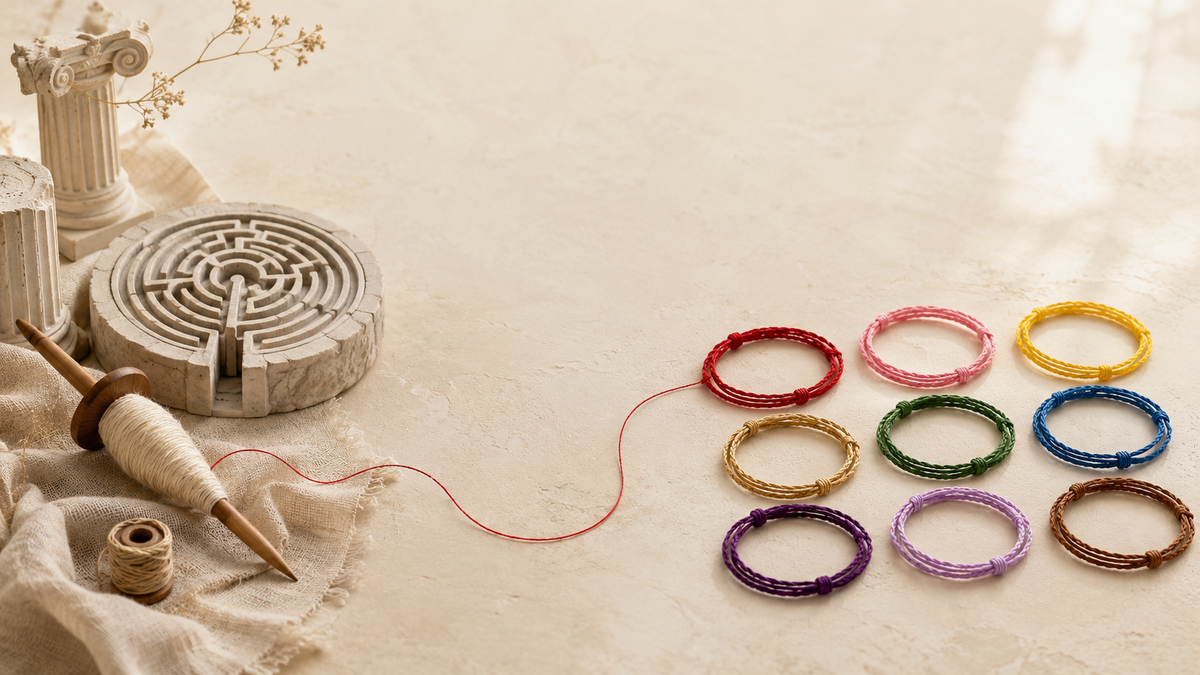
In Greek mythology, the Moirai—the Three Fates—spin, measure, and cut the thread of human life. In the story of Ariadne and Theseus, a thread becomes the guide that leads Theseus back out of the Labyrinth.
Other cultures also use spinning, weaving, cords, and threads as images for destiny, direction, life, or human connection.
These traditions are not the same story, and they do not share one single historical origin.
But together they reveal something fascinating: across very different cultures, people have repeatedly used the image of a thread to make invisible ideas—fate, connection, direction, and relationship—feel visible.
1. Why Do Threads Appear in Stories About Fate?
A thread is ordinary.
It is thin, light, and easy to overlook.
Yet once people began using spinning and weaving to make clothing, textiles, and everyday objects, thread also became a powerful metaphor.
A life can be imagined as something spun.
A relationship can be imagined as something connecting two people.
A journey can be imagined as something that follows a line.
And destiny can be imagined as something woven from countless individual moments.
The Three Fates in Greek mythology
In Greek tradition, the Moirai—often known in English as the Three Fates—are associated with the course of human life.
The imagery of spinning, measuring, and cutting the thread of life became one of the best-known Western symbols of fate.
Ariadne’s thread
In the story of Theseus and the Labyrinth, Ariadne gives Theseus a thread so that he can find his way back after entering the maze.
Here, the thread is not a symbol of romantic destiny in the same way as Yue Lao’s red cord.
It is a guide—a line that helps someone find the way back.
Threads and weaving in other traditions
Weaving and thread imagery also appear in other mythological traditions, including stories associated with fate and destiny in Northern Europe.
But these traditions should not be collapsed into one universal “red string myth.”
What they share is the human tendency to use a visible thread to imagine something we cannot physically see.
2. What Makes Taiwan’s Yue Lao Red String Different?
In Chinese folk tradition, Yue Lao (月老), short for Yue Xia Lao Ren (月下老人), is best known as a deity associated with marriage and romantic matchmaking.
One famous story describes Yue Lao connecting people who are destined to marry with a red cord.
An important detail is often lost in modern retellings:
Over time, the image of the red cord became closely associated with love, marriage, and destined encounters.
In Taiwan, however, this symbolism is not found only in old stories.
Yue Lao remains part of a living temple tradition.
People still visit temples to pray about love and marriage, and some temples provide a physical red string according to their own customs.
This is one of the things that makes Taiwan’s Yue Lao culture especially interesting to international visitors: an old symbolic idea continues to exist within contemporary religious and everyday life.
3. Is a Temple Red String the Same as an Everyday Red String Bracelet?
No.
This distinction is important, especially when introducing Yue Lao culture outside Taiwan.
A red string received from a temple
A temple red string is connected with the religious practice and customs of the temple where it was received.
Different temples may have different procedures for prayer, receiving the string, wearing it, carrying it, or storing it.
If you receive one from a temple, follow that temple’s instructions rather than assuming that every Yue Lao red string follows exactly the same rules.
A modern red string bracelet
A bracelet made by a designer or cultural brand is different.
At Yue Lao Red String Chic Check, our bracelets are handmade cultural and lifestyle accessories inspired by the familiar symbolism of Taiwan’s red string tradition.
They are made with four-strand waxed cord and designed for everyday wear.
They are not temple-issued red strings, and we do not describe them as religious objects or claim that they guarantee a particular result.
4. If the Tradition Is About a Red String, Why Does Chic Check Use Nine Colors?
Chic Check began with the familiar image of a red string.
But as the collection developed, people asked for other colors—pink, green, quieter shades, and colors that felt more like their own personalities.
That gradually became Chic Check’s nine-color collection.
The Chinese names play with the phrase 「月來月」 (yuè lái yuè), which echoes 「越來越」—a common Chinese expression meaning “more and more” or “increasingly.”
- Red|月來月圓 — May life feel more complete.
- Pink|月來月甜 — May life grow sweeter.
- Bright Yellow|月來月旺 — May life grow more prosperous.
- Gold|月來月富 — May life grow more abundant.
- Green|月來月順 — May life flow more smoothly.
- Blue|月來月穩 — May life feel more steady.
- Deep Purple|月來月好 — May life keep getting better.
- Light Purple|月來月美 — May life grow more beautiful.
- Light Brown|月來月實在 — May life feel more grounded.
They are not traditional Yue Lao temple rules, and choosing a particular color does not guarantee love, wealth, career success, or any other result.
For us, color is simply another way to turn an intention into something visible.
5. What Can a Modern Wish Bracelet Represent?
A traditional Yue Lao temple red string is most closely connected with love and marriage.
A modern Chic Check bracelet is different because it is a contemporary cultural product rather than a temple-issued religious object.
That means the person wearing it can connect it with a personal intention that matters to them.
Someone may choose one while thinking about love.
Someone else may want to remember a new goal, greater stability, a meaningful friendship, a new stage of work, or simply the courage to begin again.
These are personal intentions, not claims about Yue Lao’s religious role.
When you notice the bracelet on your wrist, you might remember:
Why did I choose this color?
What did I hope would change?
What can I do today to move one step closer to that life?
It is not superstition. It is a reminder of the intention you choose to carry.
6. Buying One for Yourself or Giving One as a Gift
A modern red string bracelet does not have to be something another person gives you.
You can choose one for yourself as a reminder of a new intention.
You can also give one to someone you care about.
In that case, the meaning does not come from a promise that the bracelet will magically change the future.
Its meaning comes from the person giving it.
“I hope things go well for you.”
“I hope this next chapter becomes a little better.”
That may be why a simple thread can still feel meaningful even in modern life.
It turns an invisible feeling—care, hope, encouragement, affection—into something another person can actually hold.
7. A Wish Is Not an Order for a Custom-Made Person
If your wish is about love, it can be helpful to think about what you truly want from a relationship.
Not only:
How tall should they be?
What job should they have?
What should they look like?
But also:
- How do I hope we communicate?
- Which values matter most to me?
- How do I want us to treat each other?
- What kind of future do I hope to build?
- Which differences can I accept?
A wish can help clarify your direction.
But another person is not a product made according to a specification sheet.
After making a wish, we still have to meet people, communicate, observe, make choices, and decide whether a relationship is healthy for both people.
Chinese guide|How to Write a Yue Lao Wish List →
8. What Does a Thread Really Connect?
The Greek Fates do not tell the same story as Yue Lao.
Ariadne’s thread is not a Taiwanese red string.
And a Chic Check bracelet is not the same thing as a red string received from a temple.
They belong to different histories and different contexts.
Yet the image of a thread continues to speak to people.
Perhaps that is because so much of human life is built from things we cannot see:
trust, memory, affection, timing, hope, promises, and the relationships that slowly change who we become.
But it can remind you of the people, choices, and hopes that give your life direction.
You may believe in fate and still make your own decisions.
You may welcome a blessing and still trust your own judgment.
You may make a wish and still take responsibility for the life you build afterward.
A Taiwan-Inspired Red String for Everyday Life
Chic Check creates handmade nine-color, four-strand waxed-cord bracelets in Taiwan, inspired by the cultural symbolism of the red string and redesigned for modern everyday wear.
Choose a color because its meaning speaks to you—or simply because you love wearing it.
Explore the Nine-Color Red String Bracelet Explore the Nine Color Meanings